Greetings still from the Miskito Coast of the Region Atlantica Autonima of Nicaragua! First a quick apology for leaving my fans waiting for so long, but between being completely off the grid for weeks (read further for an exciting overview) and the power in Puerta Cabezas vacillating between on and off every couple of hours, I just havent had the opportunity to write. but now here´s the story....
The miskito people are so called due to a set of kings that lived through out the region referred to as Reyes Moscas, or Fly Kings. They are a people that for me at first glance do not have the outward cultural brilliance of people such as the Mayans or Embera, as they no longer have traditional clothing, traditional handicrafts or overt daily customs. What fascinates one as you become immersed with the miskito people is the thick threads of history that are woven into every aspect of their being. The miskito people are not a uniform people...they are a color wheel of black, brown, chocolate, cafe, light skinned, to white; hair that is kinky, braided, straight as an asian; eyes that are deep brown, blue, green or gato as they say here. To identify a miskito person requires that you are actually in the miskitia, as the varied features of a miskito person could easily be confused with chinese, thai, balinese, japanese, latino, african, or occasionally german. The history of the miskito is one of fighting to maintain their land as different cultural groups aimed to conquer it, and as one friend said over drinks last night, they have never lost a battle. One of the main peoples were the english that have left their mark in language and food, as evidenced by the Worcestershire sauce sold at corner stores and the baking bread found at night in the markets. The african slave trade and spanish conquest also played large roles in the development of modern miskito people. The language of the miskito is probably the most culturally rich melting pot of words and expression that describes the richness of this people. It is common that miskito speak the three languages of miskito, english, and/or spanish. The indigenous language itself is as far from any language that you could possibly think. To say good afternoon you would say tetam yamni. But in this same language you have words that are distinctly english, and generally of a variety of english that has long passed. Words to describe items that were not present in the past such as spoon, door, plastic, are often heard sprinkled into a miskito conversation. Words such as dear for expensive or basin for a bowl harken to old school english. Counting is simply done in english. How much is it is Dia price, which may be answered by 5 dollar! Spanish words are also interspersed in the language. This amalgamation of words and speech color the miskito people as deeply as the variety of shades their skin take on.
Today the miskito people maintain a living that is from the sea and the land. Harvesting and using coconuts and breadfruit, diving for lobster and fishing in the deep carribean atlantic sea. They live in stilted homes, many now made of concrete, painted brightly, bringing up images of old sugar shack towns in the southern US. The one thing that still remains about the miskito people, is that they are off the grid, extremely rural. Once you have made contact they are kind, open hearted people that are thrilled to share their turtle meat with you...its just getting there thats the complication! So here is where I interject about my fabulous travel partner Cody. For those of you who are not familiar with the story he is my best friends brother and has been traveling to the miskito coast for the last five years making contacts and winning both respect and opened armed welcomes into the communities. He has been building and installing solar panel systems in the most remote areas to power lights in a world of darkness after 6 pm. It was with him that I had the wonderful opportunity to know the infrequently visited miskito communities of the north as well as the even more rural miskito keyes.
Entonces...we set out early in the morning to find a panga to take us up the coast. After securing our ride we waited as he went to get gas. We boarded the panga several hours later. Upon leaving the driver quickly began to sip from his bottle of flor de cana rum, only to become ridiculously drunk within a short period of time. When attempting to change the gas tanks he was so cross eyed that a wave hit us filling the panga with water. Quick thinking form my man told him to cut the top off our only water bottle to start bailing the water out of the boat, as there was nothing in the boat to do this with. In the meantime I am thinking, the coast isnt that far, i can swim if I have to. By the time we make it just a few miles from our destination the driver is so drunk that he is falling off the back of the boat when i say to cody, we are either getting off here or i am swimming! we disembark at a small beach in a community called Dakura, home of the most beautiful crystalline blue lagoon, to be greated by children shouting "cody, cody!" We spent the night in a home of friends only to be transported to our true final destination by sailboat across the lagoon, a 1km walk across land and then a canoe ride to the end. Just the first of many adventures to be had! To make a long story short we spent many days in a community called Sandy Bay as Cody installed a solar system and I buddied up to the local midwife Dona Esmeralda and prepared herbal solutions to put on a crazy jungle fungus growing on my back.
Later we returned to Dakura to prepare for a one week sailing trip to the Keyes. During this time was probably the largest and most important cultural event in the miskito coast: the campesion baseball series. We opted to go to Awastara to see the festivities by horse. Now most people know my history and can say, kari is a person that likes to ride horses. Ive had to rethink that opinion after sitting atop a horse that is virtually no more than a bone digging into your pelvis as you kick with all your might to get it to move. needless to say, we arrived dragging the horses and returned walking the 2 and a half hour trail.
So many stories, but by far the best and most amazing was the sailing trip that Cody organized. We set sailing in the morning of a clear day, he and I and our crew of three cien por ciento pirates. We sailed the open sea by land marks, gently pushing through the waves of the caribbean, sails high. When you imagine sailboat, I hope that you are seeing a hand built wooden hull that is painted bright blue with masts made from large widdled tree trunks and handsewn sails waving. BY the early afternoon we reached the first key called whipling, a set of 14 wooden fishing shacks set upon a sandbar in the middle of the ocean, no land to be seen. All of the keys are of this fashion, wooden houses that are stilted to withstand the hightide that reaches up to six feet, and low tide averaging around two feet. Many of the other keys are surrounded by establishments of mangroves, but still no land. So we spent the next several days, evenings, and nights watching the sunrise over one side of the ocean to set on the opposite, eating a culinary feast of lobster, conches, crabs, and fish caught earlier in the day. We eventually made it back to land with our crew of well versed pirates to arrive in time for the ripe mangos.
hope that all of you are well up there in gringolandia as spring starts to show her face!
Tuesday, March 27, 2007


Tuesday, February 20, 2007
A Tale of Strong Women
Greetings from Puerta Cabezas, in the north atlantic miskito coast!
I spent the previous week in Nicaragua volunteering at a clinic call Maria Luisa Ortiz Cooperativa in a small town of the state of Matagalpa called Mulukuku. Mulukuku today is a town that lays beside the one highway headed northtowards Puerta Cabezas, about 8 hours north of Managua. It is a little visited area, as there is not much to offer aside from a pretty view over a red steel bridge and some mandarins that you can purchase from venders on the side of the road. What is fascinating about this place is its history, or for those feminists out there, it´s herstory, as the past is mostly told through the traditon of hard working women in this community. Mulukuku was originally know for due to the large military outpost that resided on one of the hills above the river. As the military set its roots down, so did a small community on the banks of the river. The location was prime for a military station, as Mulukuku is located between Managua and the most northern points of Nicaragua. The communities around Mulukuku were small, unorganized groups of farmers, campesinos. During the sandanista revloution and ensuing contra war instigated by US influence, Mulukuku was hit hard. THe military post was damaged and the communities sacqued. Many of the people in the region were sympathizers with the sandanista revolution which was a socialist movement in the 1980s, and as such, this region was hit hard by warfare. Not to be completely destroyed by the war, it was Hurrican Juana that leveled the community. As rain poured down on the mountainous region and winds blew hard, the river flooded, taking all houses on the river banks with it. This is when the story gets interesting. There was nothing left, and there certainly wasnt going to be any government aid, and the military was gone, so what was there to do? Having been supporters of the socialist movement, the women in the region knew something of working together as a community, or cooperative. The Mulukukuan women decided to found a cooperative, the Maria Louisa Ortiz Cooperative, to build cement blocks. With these cement blocks they rebuilt homes. As the community expanded, they used blocks to build a women{s health center. Then they started a cooperative to build furniture that they could sell to support them and their community. To this day the clinic serves Mulukuku, and the recently founded Municipio de Mulukuku which includes over 24 surrounding communities. As part of the coop, a stipulation that was written into how the clinic is to be run is that any new patient arriving must have a PAP smear, regardless of why they have come to the clinic. In this way they are fighting to redue the rates of Cervical-uterine cancer in Nicaragua, which is the second highest in Latin AMerica after Haiti. THey have also recently constructed a Casa Materna birth center to address issues of maternal mortality. I was chatting one evening with a man about the women of Mulukuku and he said to me, "las mujeres aca son bravas" which translates to the women here are tough/difficult. They are a breed of women that is uncommonly seen within the third world. To give you an example here are a couple of vingettes:
Lucia: original founder of the coop, mother of seven, built and owns her own home. She continues to work cooking and cleaning, from 530 in the morning until 7ish at night. She says her work is much easier now. The volunteer house that she works at has running water.
Natali: 28 years old, daughter of original founders studies and practices natural medicine at the clinic. She has twin daughters that are 9 years old. She is empowered to give women a voice and an alternative solution.
Doña: traditional midwife whose first birth that she attended alone was her own. She has been attending her community ever since which is probably 50 years. She says that women began to seek her out because she knew more than them. She is now part of a training for community health providers.
While at Mulukuku I had the opportunity to be involved with a group of community leaders, individuals from distant communities that provide medical, legal, and community building services. Many arrive after days of travel that include 5 hour boat rides, hour long bus rides, and several hours of walking through mountainous terrain. Some can write, some can read, some have never lifted a pencil. What can be said for this grou0p of individuals is that they are dedicated to providing services to their community, they are well organized, and they are fighting to bring their communities together. They often intigrate traditonal healing practices with modern ones that they learn at these trainings. It was a very special experience for me to share with these exceptional people. After a week I was kidnapped away up to Puerta Cabezas after a surprise visit from Cody...
hope you all are well! besos, kari
p.s. to read more about the clinic and happenings in Mulukuku search on google for Dorothy Granada.
I spent the previous week in Nicaragua volunteering at a clinic call Maria Luisa Ortiz Cooperativa in a small town of the state of Matagalpa called Mulukuku. Mulukuku today is a town that lays beside the one highway headed northtowards Puerta Cabezas, about 8 hours north of Managua. It is a little visited area, as there is not much to offer aside from a pretty view over a red steel bridge and some mandarins that you can purchase from venders on the side of the road. What is fascinating about this place is its history, or for those feminists out there, it´s herstory, as the past is mostly told through the traditon of hard working women in this community. Mulukuku was originally know for due to the large military outpost that resided on one of the hills above the river. As the military set its roots down, so did a small community on the banks of the river. The location was prime for a military station, as Mulukuku is located between Managua and the most northern points of Nicaragua. The communities around Mulukuku were small, unorganized groups of farmers, campesinos. During the sandanista revloution and ensuing contra war instigated by US influence, Mulukuku was hit hard. THe military post was damaged and the communities sacqued. Many of the people in the region were sympathizers with the sandanista revolution which was a socialist movement in the 1980s, and as such, this region was hit hard by warfare. Not to be completely destroyed by the war, it was Hurrican Juana that leveled the community. As rain poured down on the mountainous region and winds blew hard, the river flooded, taking all houses on the river banks with it. This is when the story gets interesting. There was nothing left, and there certainly wasnt going to be any government aid, and the military was gone, so what was there to do? Having been supporters of the socialist movement, the women in the region knew something of working together as a community, or cooperative. The Mulukukuan women decided to found a cooperative, the Maria Louisa Ortiz Cooperative, to build cement blocks. With these cement blocks they rebuilt homes. As the community expanded, they used blocks to build a women{s health center. Then they started a cooperative to build furniture that they could sell to support them and their community. To this day the clinic serves Mulukuku, and the recently founded Municipio de Mulukuku which includes over 24 surrounding communities. As part of the coop, a stipulation that was written into how the clinic is to be run is that any new patient arriving must have a PAP smear, regardless of why they have come to the clinic. In this way they are fighting to redue the rates of Cervical-uterine cancer in Nicaragua, which is the second highest in Latin AMerica after Haiti. THey have also recently constructed a Casa Materna birth center to address issues of maternal mortality. I was chatting one evening with a man about the women of Mulukuku and he said to me, "las mujeres aca son bravas" which translates to the women here are tough/difficult. They are a breed of women that is uncommonly seen within the third world. To give you an example here are a couple of vingettes:
Lucia: original founder of the coop, mother of seven, built and owns her own home. She continues to work cooking and cleaning, from 530 in the morning until 7ish at night. She says her work is much easier now. The volunteer house that she works at has running water.
Natali: 28 years old, daughter of original founders studies and practices natural medicine at the clinic. She has twin daughters that are 9 years old. She is empowered to give women a voice and an alternative solution.
Doña: traditional midwife whose first birth that she attended alone was her own. She has been attending her community ever since which is probably 50 years. She says that women began to seek her out because she knew more than them. She is now part of a training for community health providers.
While at Mulukuku I had the opportunity to be involved with a group of community leaders, individuals from distant communities that provide medical, legal, and community building services. Many arrive after days of travel that include 5 hour boat rides, hour long bus rides, and several hours of walking through mountainous terrain. Some can write, some can read, some have never lifted a pencil. What can be said for this grou0p of individuals is that they are dedicated to providing services to their community, they are well organized, and they are fighting to bring their communities together. They often intigrate traditonal healing practices with modern ones that they learn at these trainings. It was a very special experience for me to share with these exceptional people. After a week I was kidnapped away up to Puerta Cabezas after a surprise visit from Cody...
hope you all are well! besos, kari
p.s. to read more about the clinic and happenings in Mulukuku search on google for Dorothy Granada.
Thursday, January 25, 2007
I am NOT dead!!
To all of my fans and confidants, I apologize for my lack of contact over the last month...it has been a whorlwind that has taken me all over the map of nicaragua. I write to you all today from the cozy abode of my dear friend Jana in Oakland, California, which answers a pending question that many of you have probably had. Tomorrow morning I will be interviewing at the University of San Francisco's midwifery program. It feels odd to be back in the states, so normal, and yet so far from home. So now for a quick recap of my last month.
I have had the distinct pleasure to have shared my last month with my personal tour guide and companero Cody. With him we have covered various terrains, often far from the reaches of modern society such as computers and cell phones and tourists(read: this is one excuse for why I haven't written in so long!). Traveling with a man, particularly in a very third world area, has allowed gender issues that exist in Latin American to turn to a palpable level. The idea of women's liberation and rights is far behind what a woman would experience in Mexico, and even further from a first world nation like the US. Most women's first sexual experiences in Nicaragua are violations, and as a friend told me recently, their frequency can be determined by the radial distance that a young woman lives form her local well. For myself as a white woman, I find myself embedded in a world of men, one in which few women have the opportunity to engage. Good women in Nicaragua are wives that are at home with their babies, not out socializing...a Nicaraguan proverb is that a woman is married or looking for a husband, there is no in-between. Women may also be classified as "amigas" women who are promiscuous and have sex with many men, "novias" or girlfriends which means that they may be involved in a relationship with a man for 24hours or a couple of weeks, or "esposa", a wife who only has sexual relations with one man (understand that these do not define a man's role). So in this world men are often overly polite, not truly themselves, or they completely ignore me as I don't easily fall into their catagorizations. When I walk the street with my companero or am within a circle of friends I am treated with respect and curisotiy. When I walk the street alone I fall back into the world of fresh meat...cat calls and attempted gropings!
So to leave the social realm of what it is like to be a woman in Nicaragua, what is it like for ME in Nicargua...a quick review of my parts of my itinerary:
Day one: spend the night on a private island in the isletas by Grenada, flor de cana rum in hand, with a group of fabulously gay men, who wear knee high white go-go boots and blue thong swimsuits as tour boats weave in and out of the isletas for a nicaraguan experience.
Day two: catch a ride in a new toyota corolla from Managua to Puerta Cabeza. The road is one hours worth paved, 11-20 hours (depending on your velocity) worth dirt with pot holes. Get caught in a log bridge to be fished out by passengers of the "express bus" from Managua. Arrive 5 am.
Day three: take high speed panga (boat) on wild carribean sea for two hours with Miskito family. This is truly communing with the sea when you jump several feet into the air after riding a wave only to crash down hard so that your teeth grind together as you hit the water once again. HOld onto greasy bike and little girl to avoid being thrown overboard.
Days four through six: be treated like kings in Sandy Bay, a little visited area on the northern atlantic coast of nicaragua, where you are served bread fruit, chicken feet soup, quisquisque cake, rice, and plantains. Visit local midwive refered to as a "grande" who is at least 90 years old living in a brightly painted stilted home that lookslike it could have been plucked out of early century jamaica.
Day seven: take boat trip up to Laguna de Bismuna. Buy crabs and fish directly from the boats of fishermen. Arrive at small stilted community where you are welcomed into a traditional miskito home. Learn to make miskito tortilla, have miskito language intensive class at night in the dark (no electricity except at the church) in the hammock. Sleep under pinklace mosquito net in a room with 6 other beds. Eat like kings three meals per day: fish, bread fruit, yucca, rice, miskito tortilla. Bath in the river.
Day ten: return to Puerta Cabeza via fish transport boat. SPend half of the ride like the queen of the nile, and other half been attacked by a one ton tire as you ride over deep ruts in the road, envolped by a tarp to keep out the rain and keep in the carbon dioxide and cigarette smoke. After fifteen hours ass is numb and you know that now you could take ANY ride in the world, no problem. Arrive 1 am. 1 pm board the "express" bus to Managua. Arrive 9 am the following day. Bus breaks down just frequently enough to take pee breaks!
The stories could go on and on...just imagine amazing rides, beautiful scenery, stilted homes, deep black people speaking a language that is a blend of a native tongue, colonized english and spanish, where turtle meat is a major food source, where teal and pink are common colors for wooden homes, where horses are a normal mode of transportation, where people are disabled from the sandanista and contra wars, where only young women are seen selling tortillas and homemade chees on buses coyly batting their eyes, where we eat 5 pounds of lobster tails in one sitting, drink 6 bags of home made fresco/liquad juices per day, eat raw oysters floating in their black blood in the park in Masaya...basically where anything goes and our days are filled with enjoyment! Not only am I not dead, but I am fabulously alive and sucking the marrow out of life in Nicaragua!
more soon...volunteering with doroty grenada in Mulukuku. Hope everyone is well and making it through winter. The magnolias are blooming in California!
I have had the distinct pleasure to have shared my last month with my personal tour guide and companero Cody. With him we have covered various terrains, often far from the reaches of modern society such as computers and cell phones and tourists(read: this is one excuse for why I haven't written in so long!). Traveling with a man, particularly in a very third world area, has allowed gender issues that exist in Latin American to turn to a palpable level. The idea of women's liberation and rights is far behind what a woman would experience in Mexico, and even further from a first world nation like the US. Most women's first sexual experiences in Nicaragua are violations, and as a friend told me recently, their frequency can be determined by the radial distance that a young woman lives form her local well. For myself as a white woman, I find myself embedded in a world of men, one in which few women have the opportunity to engage. Good women in Nicaragua are wives that are at home with their babies, not out socializing...a Nicaraguan proverb is that a woman is married or looking for a husband, there is no in-between. Women may also be classified as "amigas" women who are promiscuous and have sex with many men, "novias" or girlfriends which means that they may be involved in a relationship with a man for 24hours or a couple of weeks, or "esposa", a wife who only has sexual relations with one man (understand that these do not define a man's role). So in this world men are often overly polite, not truly themselves, or they completely ignore me as I don't easily fall into their catagorizations. When I walk the street with my companero or am within a circle of friends I am treated with respect and curisotiy. When I walk the street alone I fall back into the world of fresh meat...cat calls and attempted gropings!
So to leave the social realm of what it is like to be a woman in Nicaragua, what is it like for ME in Nicargua...a quick review of my parts of my itinerary:
Day one: spend the night on a private island in the isletas by Grenada, flor de cana rum in hand, with a group of fabulously gay men, who wear knee high white go-go boots and blue thong swimsuits as tour boats weave in and out of the isletas for a nicaraguan experience.
Day two: catch a ride in a new toyota corolla from Managua to Puerta Cabeza. The road is one hours worth paved, 11-20 hours (depending on your velocity) worth dirt with pot holes. Get caught in a log bridge to be fished out by passengers of the "express bus" from Managua. Arrive 5 am.
Day three: take high speed panga (boat) on wild carribean sea for two hours with Miskito family. This is truly communing with the sea when you jump several feet into the air after riding a wave only to crash down hard so that your teeth grind together as you hit the water once again. HOld onto greasy bike and little girl to avoid being thrown overboard.
Days four through six: be treated like kings in Sandy Bay, a little visited area on the northern atlantic coast of nicaragua, where you are served bread fruit, chicken feet soup, quisquisque cake, rice, and plantains. Visit local midwive refered to as a "grande" who is at least 90 years old living in a brightly painted stilted home that lookslike it could have been plucked out of early century jamaica.
Day seven: take boat trip up to Laguna de Bismuna. Buy crabs and fish directly from the boats of fishermen. Arrive at small stilted community where you are welcomed into a traditional miskito home. Learn to make miskito tortilla, have miskito language intensive class at night in the dark (no electricity except at the church) in the hammock. Sleep under pinklace mosquito net in a room with 6 other beds. Eat like kings three meals per day: fish, bread fruit, yucca, rice, miskito tortilla. Bath in the river.
Day ten: return to Puerta Cabeza via fish transport boat. SPend half of the ride like the queen of the nile, and other half been attacked by a one ton tire as you ride over deep ruts in the road, envolped by a tarp to keep out the rain and keep in the carbon dioxide and cigarette smoke. After fifteen hours ass is numb and you know that now you could take ANY ride in the world, no problem. Arrive 1 am. 1 pm board the "express" bus to Managua. Arrive 9 am the following day. Bus breaks down just frequently enough to take pee breaks!
The stories could go on and on...just imagine amazing rides, beautiful scenery, stilted homes, deep black people speaking a language that is a blend of a native tongue, colonized english and spanish, where turtle meat is a major food source, where teal and pink are common colors for wooden homes, where horses are a normal mode of transportation, where people are disabled from the sandanista and contra wars, where only young women are seen selling tortillas and homemade chees on buses coyly batting their eyes, where we eat 5 pounds of lobster tails in one sitting, drink 6 bags of home made fresco/liquad juices per day, eat raw oysters floating in their black blood in the park in Masaya...basically where anything goes and our days are filled with enjoyment! Not only am I not dead, but I am fabulously alive and sucking the marrow out of life in Nicaragua!
more soon...volunteering with doroty grenada in Mulukuku. Hope everyone is well and making it through winter. The magnolias are blooming in California!
Tuesday, December 26, 2006
Beauty and the Break
On a completely different note form medicine, healing, and traditional practices, i have spent the last couple of weeks in Costa Rica on Vacation. Thats right, the kind where you lay on the beach all day long and dont even have time to read your book. Costa Rica has been an interesting contrast to the first months of my trip which were peppered with brilliantly colored indiengous women, children, and their artisanry. Costa Rica, in contrast, is a country that has greatly suceeded in the realm of tourism, so much so that my sister and I have taken to calling various areas that we have visited "little america". One of the reasons that CR has been so successful is that the country sits within a rich and varied environement with awe inspiring natural wonders. One of the best moments that I shared with my family on this portion of my journey was my mother waking me up from a deep sleep at 4:30 in the morning to behold unbeleivably red, molten lava pouring down the sides of Volcan Arenal in northern costa rica. My impression of CR is that one visits it not to immerse themself in a magical, colorful, different culture, but to enjoy the natural beauty that has developed into a tourist industry. Rather than maintain an expectation that you are actually leaving the united states of america, I profess that it is better to "dive" into the nature of this country in order to experience it. How better to do this than to push your own personal limits to commune with nature.
To give a bit of background, my sister, Sara, is a hardcore adventurer and advocate of nature and best sister ever. After discussions with her I have been able to develop a new philosophy and understanding of how to interact with nature, a philosophy that has required me to rethink my own phobias and anxieties...I call this new philsophy surfing. Anyone who knows me well would assume that I would not surf, that the shear terror of facing a large wave crashing down on my head would be inconceivable. My first session surfing I carried a ridiculously large long board into the ocean, which turned around to beat me as I battled the white wash of waves breaking in front of me in Mal Pais on the southern nicoya penninsula (bruises to prove it!). I spent 2&30 hours gliding on white wash waves (the foamy stuff) and attempting to stand up. After three surf sessions I was able to stand on my board for approximately 1.2 seconds. Yet I still hadn´t paddled out behind the break, I still hadnt caught what is called a green wave, and I was still anxious about the power of the ocean...but I was out there, but i wasnt really surfing. Today, Sara and I traveled to Tamarindo to get some morning surf. We woke up at 6 am, iced coffee in hand, armed for our one hour drive over intermittently paved roads to reach the beach. Its incredible how waves can look docile and small from the shore, and how powerful they are when they are crashing on top of you as you paddle with all of your might, certain that you are swimming in place. It may then seem as if it is by some christmas miracle you end up on behind the break. From there you can sit on your surfboard and embrace the shear beauty of the ocean...you know she is big, strong, and much more powerful than you, but somehow you have finally connected with the spirit of the sea. The first time you get completely pummled by the wave, swallowing at minimum thirty five gallons of salt water, expereincing a complete nasal irrigation, and then paddle back out for more, you are living the philosophy that the ocean yes, is stronger than you, but you want to be with her for the few short seconds that she actually locks onto your surfboard and draws you towards the sandy beach, only to swallow you up in the white wash again. This is what my sister calls communing with nature. I paddled back out for more...thanks sis!
happy holicays and new years! surfs up!
To give a bit of background, my sister, Sara, is a hardcore adventurer and advocate of nature and best sister ever. After discussions with her I have been able to develop a new philosophy and understanding of how to interact with nature, a philosophy that has required me to rethink my own phobias and anxieties...I call this new philsophy surfing. Anyone who knows me well would assume that I would not surf, that the shear terror of facing a large wave crashing down on my head would be inconceivable. My first session surfing I carried a ridiculously large long board into the ocean, which turned around to beat me as I battled the white wash of waves breaking in front of me in Mal Pais on the southern nicoya penninsula (bruises to prove it!). I spent 2&30 hours gliding on white wash waves (the foamy stuff) and attempting to stand up. After three surf sessions I was able to stand on my board for approximately 1.2 seconds. Yet I still hadn´t paddled out behind the break, I still hadnt caught what is called a green wave, and I was still anxious about the power of the ocean...but I was out there, but i wasnt really surfing. Today, Sara and I traveled to Tamarindo to get some morning surf. We woke up at 6 am, iced coffee in hand, armed for our one hour drive over intermittently paved roads to reach the beach. Its incredible how waves can look docile and small from the shore, and how powerful they are when they are crashing on top of you as you paddle with all of your might, certain that you are swimming in place. It may then seem as if it is by some christmas miracle you end up on behind the break. From there you can sit on your surfboard and embrace the shear beauty of the ocean...you know she is big, strong, and much more powerful than you, but somehow you have finally connected with the spirit of the sea. The first time you get completely pummled by the wave, swallowing at minimum thirty five gallons of salt water, expereincing a complete nasal irrigation, and then paddle back out for more, you are living the philosophy that the ocean yes, is stronger than you, but you want to be with her for the few short seconds that she actually locks onto your surfboard and draws you towards the sandy beach, only to swallow you up in the white wash again. This is what my sister calls communing with nature. I paddled back out for more...thanks sis!
happy holicays and new years! surfs up!
Friday, December 01, 2006
Hold a Bowl of Blood with both Hands
...or a list of things that I love about San Cristobal, Chiapas, and my work here.
*Walking out of my house along a street of beautiful spanish colonial buildings, then through a Mayan settlement to walk by a beautiful mountain river and up a hill covered with pine and madrone trees, to have a fantastic view of San Cristobal and its Guadalupe Church
*When a woman tears after giving birth that we apply seaweed topically to assist in the mending of the tissue. Thats right, vaginal sushi!
*Mayan women who wash their laundry in the river, and then leave everything to dry atop trees and shrubs along the shore while their children laugh and tumble in the grass.
*Hearing the same stupid norteño song everyday, ten times a day, until you have to admit that now you love the song.
*A month after a woman has given birth we provide a "closing" which includes an herbal bath of seven plants (including rosemary and laurel...the rest are unknown, and the ancient market woman will not reveal the secret!) in which the whole family gets in. This is really special because bathtubs are nearly unknown in Mexico. Afterward the woman is given a massage, now which includes Mayan Abdominal Massage, and then a rebozo massage in which a Mexican shawl is used to rock the woman and close her hips. Its a perfect integration of western medicine and traditional healing techniques.
*Fresh popped palomitas (popcorn) in the market for 1 peso (ten cents!)
*Having the opportunity to learn women´s health and midwifery care in a very free environment unavailable in the US. I am constantly amazed at the experiences the patients at Luna Maya have shared with me from their prenatal care, births, postnatal care, well woman care, etc. I have learned how to do PAP smears, identify vaginal irritations post birth, assist with lactation, care for women during birth, and approach mexican women in a more culturally appropriate way. To top it all off its a constant spanish lesson! Added to this is my joy of sharing my work with the Mexican women. I have had the opprtunity to provide sessions (I´m now a pro at teaching Abdominal self care massage in spanish!) and teach workshops.
*Spending a weekend in Oconsingo and Palenque where my experiences included:
1. Being stuck in a bus station for three extra hours because the road was out due to a rainstorm. While there I had a conversation with a young woman on her way out to work in a hotel in Cancun. She told me everything she knew about US culture which included the fact that we ALL have blue eyes in the US, and that it is sunny and warm in the US all the time. I unfortunately had to tell her the truth!
2. Finding a guide to take me and a couple of Spanish freinds into the jungle of Palenque an abandoned Mayan city. We hiked through the mud until we found an entirely forest covered temple...it made us think that this must have been what it was like when the first anthropologists had come into the area. Later, our Mayan guide, descendant of a Mayan Shaman, proceeded to give me a traditional Mayan treatment that consisted of him pushing a crystal and a jaguar tooth into various points on my forehead and joints. He told me that I think to much, often considering three topics at the same time, and that I need to learn to connect myself more to the earth. What do you think?
Lastly, I thought I would just answer a question that a friend asked me in a recent email, whether my work here has given me more or less hope for the fate of humanity. My answer is more hope. I beleive that by being involved in an organization that is breaking down the traditonal stereotypes and roles of what a woman is in mexico is priceless. Being involved with "humanizing birth" changes interfamily relationships and promotes more understanding in the larger global community. The road is difficult, similar to anyroad or side walk that you find in Mexico or Latin America. Sometimes you have a clear flat path to walk on for a few feet, then you realize a family is walking toward you and you must decisively choose who goes to the inside and who to the outside of the three foot wide track, then you have to jump off the bank to avoid a large crack, and then quickly get back up again to avoid the taxi speeding at your back. There are lots of obstacles, but you eventually get somewhere...you also realize that the road that you took was alot more fun than just walking blindly down a perfectly poured concrete slab.
*Walking out of my house along a street of beautiful spanish colonial buildings, then through a Mayan settlement to walk by a beautiful mountain river and up a hill covered with pine and madrone trees, to have a fantastic view of San Cristobal and its Guadalupe Church
*When a woman tears after giving birth that we apply seaweed topically to assist in the mending of the tissue. Thats right, vaginal sushi!
*Mayan women who wash their laundry in the river, and then leave everything to dry atop trees and shrubs along the shore while their children laugh and tumble in the grass.
*Hearing the same stupid norteño song everyday, ten times a day, until you have to admit that now you love the song.
*A month after a woman has given birth we provide a "closing" which includes an herbal bath of seven plants (including rosemary and laurel...the rest are unknown, and the ancient market woman will not reveal the secret!) in which the whole family gets in. This is really special because bathtubs are nearly unknown in Mexico. Afterward the woman is given a massage, now which includes Mayan Abdominal Massage, and then a rebozo massage in which a Mexican shawl is used to rock the woman and close her hips. Its a perfect integration of western medicine and traditional healing techniques.
*Fresh popped palomitas (popcorn) in the market for 1 peso (ten cents!)
*Having the opportunity to learn women´s health and midwifery care in a very free environment unavailable in the US. I am constantly amazed at the experiences the patients at Luna Maya have shared with me from their prenatal care, births, postnatal care, well woman care, etc. I have learned how to do PAP smears, identify vaginal irritations post birth, assist with lactation, care for women during birth, and approach mexican women in a more culturally appropriate way. To top it all off its a constant spanish lesson! Added to this is my joy of sharing my work with the Mexican women. I have had the opprtunity to provide sessions (I´m now a pro at teaching Abdominal self care massage in spanish!) and teach workshops.
*Spending a weekend in Oconsingo and Palenque where my experiences included:
1. Being stuck in a bus station for three extra hours because the road was out due to a rainstorm. While there I had a conversation with a young woman on her way out to work in a hotel in Cancun. She told me everything she knew about US culture which included the fact that we ALL have blue eyes in the US, and that it is sunny and warm in the US all the time. I unfortunately had to tell her the truth!
2. Finding a guide to take me and a couple of Spanish freinds into the jungle of Palenque an abandoned Mayan city. We hiked through the mud until we found an entirely forest covered temple...it made us think that this must have been what it was like when the first anthropologists had come into the area. Later, our Mayan guide, descendant of a Mayan Shaman, proceeded to give me a traditional Mayan treatment that consisted of him pushing a crystal and a jaguar tooth into various points on my forehead and joints. He told me that I think to much, often considering three topics at the same time, and that I need to learn to connect myself more to the earth. What do you think?
Lastly, I thought I would just answer a question that a friend asked me in a recent email, whether my work here has given me more or less hope for the fate of humanity. My answer is more hope. I beleive that by being involved in an organization that is breaking down the traditonal stereotypes and roles of what a woman is in mexico is priceless. Being involved with "humanizing birth" changes interfamily relationships and promotes more understanding in the larger global community. The road is difficult, similar to anyroad or side walk that you find in Mexico or Latin America. Sometimes you have a clear flat path to walk on for a few feet, then you realize a family is walking toward you and you must decisively choose who goes to the inside and who to the outside of the three foot wide track, then you have to jump off the bank to avoid a large crack, and then quickly get back up again to avoid the taxi speeding at your back. There are lots of obstacles, but you eventually get somewhere...you also realize that the road that you took was alot more fun than just walking blindly down a perfectly poured concrete slab.
Monday, November 27, 2006
Bio-piracy or Bio-protecting?
A major theme here in Chiapas is that of protecting and honoring traditional knowledge. This is a land forged by the revolution of the zapatistas, a movement that gave voice to a massivly oppressed population. The indigenous of Chiapas and Mexico continue to be persecuted as witnessed by the rage in Oaxaca where protesters are currently burning government buildings, or by the unpublicized massacres that are occuring in the jungle. BOrn out of these struggles are many organizations that are fighting to maintain traditional knowledge as well as create economic opportunites for the impoverished peoples of Chiapas. For example is OMIECH an organization directed at preserving indigenous knowledge related to medicine, including the practice of midwifery and use of herbal medicines. OMIECH has created an ample museum discussing the cosmovision behind Mayan healing techniques, as well as an herbal apothecary where you can purchase your cough syrups or tea blends for what ails you. Invested into this interest is a desire to retain this knowledge in the hands of the people who are born into it, i.e. the Mayan midwives. A term that is commonly used in the world of ethnobotanists, herbalists, and anthropologists is bio-piracy, described as the appropriation of biologically based knowledge by outsiders (read pirates) for their economic benefits, such as a pharmaceutical company prosepecting for new drugs. The fear is that these pirates will capitalize on these ventures without giving anything back to the communities ($$). While bio-piracy is a true threat of which I have genuine interest, no topic is ever cut-and-dry. Since arriving in San Cristobal I have attempted to make a conneciton at OMIECH to try to reveal local plants that can be used for very common disorders affecting pregnant women ( anemia, swelling, promoting labor) to be used by local women, only to have the door closed on me. Let it be known that my motives were well described with information provided on the organization that I am working with. My intellectual question is, ¿is there a point at which protecting knowledge be comes concealing it, contributing to a further loss of knowledge, or one that causes this knowledge to become theoretical rather than practiced because it is not shared? Is the desire to have a finacial reward for knowledge prohibiting its dissemination, and worse preventing its access to its very community? These are topics that I dwell on as I find myself religated to books to try to discern useful medicinal plants, rather than having the honor to learn from those who tightly hold onto this knowledge.
On another note, we welcome to the world this morning Octavio, born into the simple home of Angelica. THis birth was a reminder that the miracle of life transcends any economic situation, that the spark of life is perceivable in all corners, rich or poor. The act of this birth was also a deep reminder of the ecstasy of love...how the moment of birth is a sexual experience, brought on by love, propelled by the horomones of sexuality, how the child is birthed through orgasm, at which point that new little life enters into the world to be brought to the breast of its mother who calls out to her child "aye mi rey" (my king).
hugs and kisses, abrazos y besos
On another note, we welcome to the world this morning Octavio, born into the simple home of Angelica. THis birth was a reminder that the miracle of life transcends any economic situation, that the spark of life is perceivable in all corners, rich or poor. The act of this birth was also a deep reminder of the ecstasy of love...how the moment of birth is a sexual experience, brought on by love, propelled by the horomones of sexuality, how the child is birthed through orgasm, at which point that new little life enters into the world to be brought to the breast of its mother who calls out to her child "aye mi rey" (my king).
hugs and kisses, abrazos y besos
Tuesday, November 21, 2006
Bienvenido al Mundo
In the mornings that I have spent in the workshop space at Luna Maya I have read on the white board the words "para cambiar como vivir, debemos cambiar como nacer" to change the way we live we must change the way we are born. These have been very poignant words as I have delved more deeply into the world of midwifery and birth here in San Cristobal. I have faced this issue by looking into the many facets of how we birth. One aspect is who we birth with. In the united states most women choose to give birth in a hospital environment, in case something goes wrong. The midwives here at Luna Maya and I have discussed this concept thoroughly. To choose a hospital just in case, is based on a general assumption that something will go wrong, that as women we do not have the capacity to birth. When we know, either consciously or not, that hospitals can offer c-sections and emergency care, it begins to chip away at our resolve to push our babies out into the world. The united states suffers from one of the highest rates of c-section in the western world. Those countries that have the lowest rate of c-section (nederlands and scandanavia) are those in which women are attended to primarily by midwives. So where does Mexico fit in this picture? Mexico suffers from the second highest rate of c-section world wide after Chile, between 40-70% depending on the hospital. To choose to give birth in a hospital is akin to signing a waiver allowing a physician to slice into your belly to bring your child into the world. Mexico, though, still relies on midwives in various rural and impoverished areas. This midwives are often refered to as "traditional" midwives who have received information passed down from elders in their communities. A prominent issue with traditional midwives is what i have deemed "el sindrome de estar en medio" or the sindrome of being in the middle. This is a complex of symptoms that I have seen played out all over mexico and developiong countries. To be put simply, when globalization or development influences a loss of traditional customs and knowledge in exchange for "newer and better" ideas often leaving entire populations in the middle. For example, urbanization: people give up their simple homes in rural areas to move to the city. They exchange good soil and access to water for a hovel in the city where water must be purchased in order to work for an industry and earn $$; another example is a woman that is brought up in a family that has left its traditional community in which she would have seen women birth babies and breasfeed, to be in a more modern community in which birth is not discussed. In the moment that she is faced with actual labor her level of fear is so great that she needs to be constantly coaxed back into her body, she has never seen a woman breastfeed and relies on a male doctor in a hospital who is not trained in lactation to attend her. To bring this discussion back to the tradtional midwives, many of them have been trained in western medical techniques such as the use of injections of Pitocin, a synthetic version of Oxytocin a hormone that is released during labor to promote contractions. It is now assumed that when a woman in labor goes to a traditional mayan midwife she will receive an injection, when an injection is not provided her skills are brought into question. With this reliance on modern medicines her knowledge of normal, unassisted birth declines. Not only is she left in the middle with a loss of her communities traditional knowlegde and a mis-managment/understanding of western medicine, but her patients are also left in this limbo, being hung between the worlds of tradition and medical science. Basically they are jodido, stuck in the middle with nothing!
This last thursday i was given the honor to be at my first birth here at Luna Maya. She was a fifteen year old mexican woman whose family had disowned her when she ran away from home to be with her boyfriend. They decided to get pregnant, coming to Luna Maya at the first signs of labor. Not only had she virtually had no prenatal care, she had no idea what to expect during birth. After three days of ¨practice contractions¨she returned to the clinic to truly birth. She was supported by a fabulous team of myself, cris the midwife, her spanish muslum assistant Sayida, and another apprentice jennifer. It took all four of us to support her through the birth, remind her to breath, and tell her that she could do it as she gazed out the window between contractions. The beauty of this birth was watching how a woman who has been given no training, and who has no understanding of birth or her body could actually bring her child into this world with the right support team. She labored for apporximately 12 hours and then pushed for one. She had no desire to connect with her baby, and didn´t talk to him after he was welcomed into the world by his midwifery team. It is beleived that a common cause of hemorrhage post birth is this lack of connection with one´s baby, a complication that occured and was easily handled in the clinic. Almost a week later the baby still doesn´t have a name, but is grow healthily here in San Cristobal. This young woman seemed to embody this sindrome de estar en medio, having been brought up in a community that has lost the ability to share the womanly arts of birthing and breastfeeding, having no experience or knowledge, leaving her dangling in the middle. Her birth was not that of an empowered woman wanting to take back birth, nor was it of an indigenous woman who was confident in her body´s abilities. All that said, it is still a miracle to watch a new life take its first breath...Bienvenido bebe!
This last thursday i was given the honor to be at my first birth here at Luna Maya. She was a fifteen year old mexican woman whose family had disowned her when she ran away from home to be with her boyfriend. They decided to get pregnant, coming to Luna Maya at the first signs of labor. Not only had she virtually had no prenatal care, she had no idea what to expect during birth. After three days of ¨practice contractions¨she returned to the clinic to truly birth. She was supported by a fabulous team of myself, cris the midwife, her spanish muslum assistant Sayida, and another apprentice jennifer. It took all four of us to support her through the birth, remind her to breath, and tell her that she could do it as she gazed out the window between contractions. The beauty of this birth was watching how a woman who has been given no training, and who has no understanding of birth or her body could actually bring her child into this world with the right support team. She labored for apporximately 12 hours and then pushed for one. She had no desire to connect with her baby, and didn´t talk to him after he was welcomed into the world by his midwifery team. It is beleived that a common cause of hemorrhage post birth is this lack of connection with one´s baby, a complication that occured and was easily handled in the clinic. Almost a week later the baby still doesn´t have a name, but is grow healthily here in San Cristobal. This young woman seemed to embody this sindrome de estar en medio, having been brought up in a community that has lost the ability to share the womanly arts of birthing and breastfeeding, having no experience or knowledge, leaving her dangling in the middle. Her birth was not that of an empowered woman wanting to take back birth, nor was it of an indigenous woman who was confident in her body´s abilities. All that said, it is still a miracle to watch a new life take its first breath...Bienvenido bebe!
Thursday, November 02, 2006
Dia de los muertos
El dia de los muertos...Noche de Muertos...Day of the Dead
In Mexico the day of the dead is a widely celebrated holiday beginning on November first through the second. It is reknowned for being celebrated the most diligently in the state of Michoacan by the purepecha indigenous women living around the lake of Pazcuaro. Because the celebrations begin in the late evening and continue until early the next morning, I packed my bags up, checked out of the hostel in Morelia and set out to Pazcuaro with a fellow traveler to spend the entire night watching the festivities. At the last moment we chose the touristy route for celebrating the day of the dead, heading out to Pazcuaro to visit the artesan market that was full with delicious local candies, cookies, and sweets, including a variety of sugary skulls and skeletons used to decorate grave sites, and elaborate Catrinas, painted female skeleton statues. After spending hours reveiwing the local handicrafts we began an hour walk down to the dock in Pazcuaro where we boarded a lancha (long motor boat) to the island of Janitzio. The energy at the dock was very festive, with live Mexican brass bands playing, chattering spanish, and excited children. I noted that as part of the "touristy route" most people visiting the island were Mexican, not foreigners. The boat ride was about 40 minutes, strangely, on a lake to an island that I had never seen by day light. Once on the island the mood differed, it was a bit more subtle, yet not solemn. No brass bands playing, yet music still chimed out amidst the shouts of Purpecha women selling chili rellenos, fried fish, and quesadillas. The island itself is a small hill, born out of the water, covered from top to bottom in small concrete homes. Staircases climb in a circular labyrinth culminating at a large statue of Morelos, the patorn of Michoacan and hero of Mexican independance. Half way up the island hill was the cemetary, the panteon, which we had all come to visit. It is on the evening of the day of the dead when Purepecha women sit vigil at the graves of their loved ones through the entire night. They come to the graves, arms full with marigolds, flor de terciopelo, fresh fruits, breads (pan de muerto), and sweets to pacify the souls of the dead. It is beleived in Mexico, as it is in many cultures around the world, that this day is when the veils between the worlds of the living and dead are thin, so that the dead may travel across into the world of the living. The bright yellow marigolds that harken visions of pumpkins, ripe fruit, and autumn moments in the united states, are used to guide the dead to their grave sites where their families await them, their scent calling the spirits. The goodies, such as their favorite beer and tobacco, and pan de muerto are left as offerings to the espiritus. Beginning at around midnight families begin their procession down to the graveyard, setting up their alters, lighting candles, and bundling themselves up in their rebozos to hold their vigil until the morning. It is a quite ceremony, no singing, little talking, mostly held by the grandmothers (abuelas), mothers, and young women of the community. We held vigil in the cemetery with these women, hiking to the top of the hill and back to the twinkiling white candles of the cemetery, constantly shocked by the richness of color and tradition that met us in the cemetery. As light began to fill the sky and bath the small island, I saw it for the first time through the light of day. I realized that I had never spent a night in a cemetary, and that I had celebrated the day of the dead as these Purepecha women had for generations: watching the morning light dance over the graves of their beloved ones.
A few thoughts of mine on the Day of the Dead in Michoacan:
Their reverance of the dead and the transitions of life are a powerful lesson for a western minded women such as myself and many others who have never been taught to speak of death. An english woman that I met said that she was fascinated by the ritual, yet found it really creepy. When we discussed it more it was due to this fear of death with which we are enculcated from a young age.
I thought of the dedication of the familial unit in Mexico. How family is so important that even the dead are honored and revered. Secondly, that this reverence isnt a passing event, but an annual ritual shared with all of its members. Specifically for women, it is their role to light the candle of rememberance and ensure that it reamins burning through the generations of their families.
The use of plants in ritual is a potent reminder of the tranistions of life and death through the change of the seasons. The marigolds are full with life at this time of the year, equally with many foods such as pumpkins and apples, whereas many other foods begin to ferment and die as the season changes into winter. They are a tangible reminder of the fruitfullness of summer and of what is to come for winter.
Thanks for reading! Sleep well knowing the dead have been pacified with tequila and sugary skulls for yet another year!!
In Mexico the day of the dead is a widely celebrated holiday beginning on November first through the second. It is reknowned for being celebrated the most diligently in the state of Michoacan by the purepecha indigenous women living around the lake of Pazcuaro. Because the celebrations begin in the late evening and continue until early the next morning, I packed my bags up, checked out of the hostel in Morelia and set out to Pazcuaro with a fellow traveler to spend the entire night watching the festivities. At the last moment we chose the touristy route for celebrating the day of the dead, heading out to Pazcuaro to visit the artesan market that was full with delicious local candies, cookies, and sweets, including a variety of sugary skulls and skeletons used to decorate grave sites, and elaborate Catrinas, painted female skeleton statues. After spending hours reveiwing the local handicrafts we began an hour walk down to the dock in Pazcuaro where we boarded a lancha (long motor boat) to the island of Janitzio. The energy at the dock was very festive, with live Mexican brass bands playing, chattering spanish, and excited children. I noted that as part of the "touristy route" most people visiting the island were Mexican, not foreigners. The boat ride was about 40 minutes, strangely, on a lake to an island that I had never seen by day light. Once on the island the mood differed, it was a bit more subtle, yet not solemn. No brass bands playing, yet music still chimed out amidst the shouts of Purpecha women selling chili rellenos, fried fish, and quesadillas. The island itself is a small hill, born out of the water, covered from top to bottom in small concrete homes. Staircases climb in a circular labyrinth culminating at a large statue of Morelos, the patorn of Michoacan and hero of Mexican independance. Half way up the island hill was the cemetary, the panteon, which we had all come to visit. It is on the evening of the day of the dead when Purepecha women sit vigil at the graves of their loved ones through the entire night. They come to the graves, arms full with marigolds, flor de terciopelo, fresh fruits, breads (pan de muerto), and sweets to pacify the souls of the dead. It is beleived in Mexico, as it is in many cultures around the world, that this day is when the veils between the worlds of the living and dead are thin, so that the dead may travel across into the world of the living. The bright yellow marigolds that harken visions of pumpkins, ripe fruit, and autumn moments in the united states, are used to guide the dead to their grave sites where their families await them, their scent calling the spirits. The goodies, such as their favorite beer and tobacco, and pan de muerto are left as offerings to the espiritus. Beginning at around midnight families begin their procession down to the graveyard, setting up their alters, lighting candles, and bundling themselves up in their rebozos to hold their vigil until the morning. It is a quite ceremony, no singing, little talking, mostly held by the grandmothers (abuelas), mothers, and young women of the community. We held vigil in the cemetery with these women, hiking to the top of the hill and back to the twinkiling white candles of the cemetery, constantly shocked by the richness of color and tradition that met us in the cemetery. As light began to fill the sky and bath the small island, I saw it for the first time through the light of day. I realized that I had never spent a night in a cemetary, and that I had celebrated the day of the dead as these Purepecha women had for generations: watching the morning light dance over the graves of their beloved ones.
A few thoughts of mine on the Day of the Dead in Michoacan:
Their reverance of the dead and the transitions of life are a powerful lesson for a western minded women such as myself and many others who have never been taught to speak of death. An english woman that I met said that she was fascinated by the ritual, yet found it really creepy. When we discussed it more it was due to this fear of death with which we are enculcated from a young age.
I thought of the dedication of the familial unit in Mexico. How family is so important that even the dead are honored and revered. Secondly, that this reverence isnt a passing event, but an annual ritual shared with all of its members. Specifically for women, it is their role to light the candle of rememberance and ensure that it reamins burning through the generations of their families.
The use of plants in ritual is a potent reminder of the tranistions of life and death through the change of the seasons. The marigolds are full with life at this time of the year, equally with many foods such as pumpkins and apples, whereas many other foods begin to ferment and die as the season changes into winter. They are a tangible reminder of the fruitfullness of summer and of what is to come for winter.
Thanks for reading! Sleep well knowing the dead have been pacified with tequila and sugary skulls for yet another year!!
Tuesday, October 31, 2006
Beinvenido a Mexico
I spent my days of my trip in Guanajuato, the first place my feet had touched soil in Mexico over four years ago. Its a fabulous colonial town set in the middle of a valley and extending outwards, filling the entire bowl of land with colorful homes reached by steep steps extending through the endless network of callejones (alleys). I found myself nostalgic for those first moments when I had eaten a taco al pastor, heard the sights and sounds of my first marketplace, and those moments when I would be terribly lost amongst the alleyways, only to come upon an amazing, sheltered plaza with a fountain that hadn´t been used in fifty years. While there I had the opportunity to assist my friend Erick, aka Dr. G, as a translator in a medical clinic (which is a startling change from the first time I was in Guanjuato and fumbled throught the days with my broken Spanish!). It proved to be an interesting introduction for me to the medical system in Mexico, and my medical/herbal/traditional healing guided trip. Here are some tidbits for you all to savor:
-a doctor is paid $40 per day for 8-10 hours of work
-a reasonable home close to the center of town is the equivalent of $300-400 monthly
-average minimum salary in Mexico is $4 per day
-there are a few varieties of healthcare programs in Mexico, the clinic that we visited was for union and government workers. As a patient you may wait for hours to see the physician for 15 minutes (¿sounds farmiliar?)
-within the government hospital the physician may only reccomend medications from a fixed list. Recommendation of drugs outside of that list may case that doctor´s termination.
-an impromtu conversation with a physician in a cafe revealed that he couldn´t pay his bills if he didn´t have another job: he works at the clinic and has a private practice, meaning he works virtually everyday. He also quite liberally expounded upon the corruption within a public health system that has been developed to "assist" the poor. His beleif was that it just trickled money back into the hands of the government and didn´t reach those who neded it.
-lack of communication between the various healthcare systems appears to cause failures in providing adequate care, particularly to the underserved population. One group might have excesses of a medicaiton that are needed within another group, etc.
-I think people are coughing and suffering respiratory illness from the visible levels of air pollution!
I guess the point of this discussion is to show that healthcare systems in most countries are simply a mess. In the words of the formally interveiwed doctor, its our job to make changes, to work, and struggle to see these changes affect one person, then their families, and ripple further outward to affect the world.
With many blessings sent out to all of you on the pungently scented waves of marigolds decorating every corner of Morelia, Michoacan in preparation for the day of the dead!
abrazos y besos
-a doctor is paid $40 per day for 8-10 hours of work
-a reasonable home close to the center of town is the equivalent of $300-400 monthly
-average minimum salary in Mexico is $4 per day
-there are a few varieties of healthcare programs in Mexico, the clinic that we visited was for union and government workers. As a patient you may wait for hours to see the physician for 15 minutes (¿sounds farmiliar?)
-within the government hospital the physician may only reccomend medications from a fixed list. Recommendation of drugs outside of that list may case that doctor´s termination.
-an impromtu conversation with a physician in a cafe revealed that he couldn´t pay his bills if he didn´t have another job: he works at the clinic and has a private practice, meaning he works virtually everyday. He also quite liberally expounded upon the corruption within a public health system that has been developed to "assist" the poor. His beleif was that it just trickled money back into the hands of the government and didn´t reach those who neded it.
-lack of communication between the various healthcare systems appears to cause failures in providing adequate care, particularly to the underserved population. One group might have excesses of a medicaiton that are needed within another group, etc.
-I think people are coughing and suffering respiratory illness from the visible levels of air pollution!
I guess the point of this discussion is to show that healthcare systems in most countries are simply a mess. In the words of the formally interveiwed doctor, its our job to make changes, to work, and struggle to see these changes affect one person, then their families, and ripple further outward to affect the world.
With many blessings sent out to all of you on the pungently scented waves of marigolds decorating every corner of Morelia, Michoacan in preparation for the day of the dead!
abrazos y besos
Sunday, September 24, 2006
Friday, September 15, 2006
Pre-expedition musings
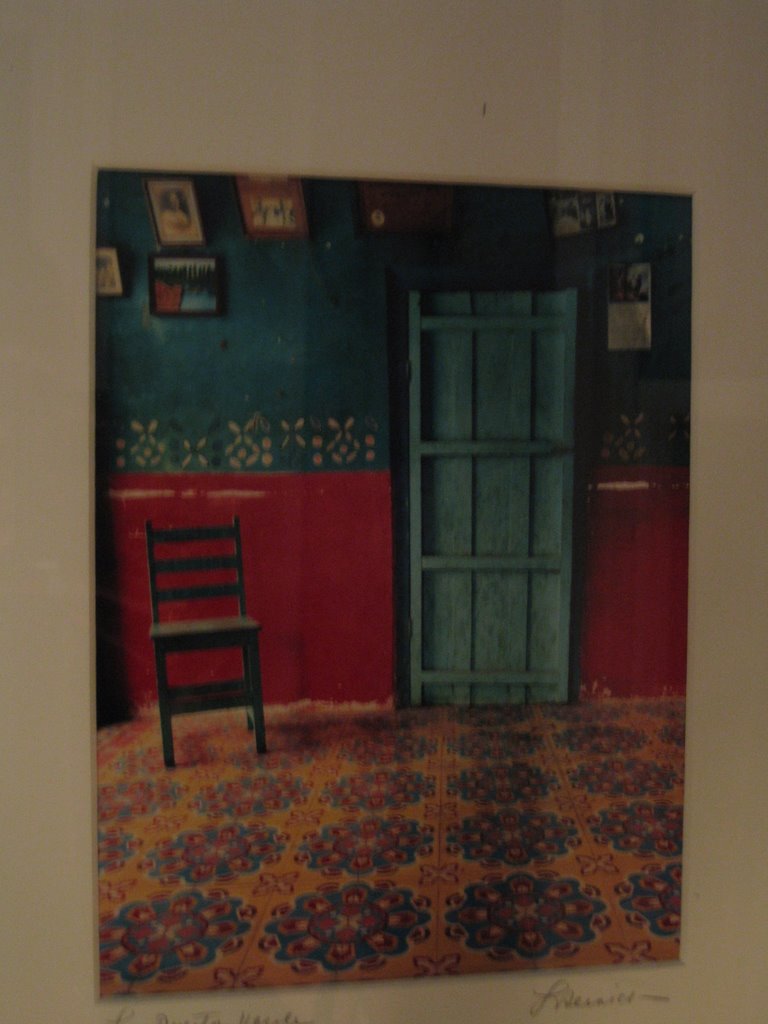
Last summer I decide that I wanted to take a chance on traveling in Latin America for an extended period of time. With that decision, I wanted my travels to be full of discovery and research and decided that earning a Fulbright grant would be the best way to pursue this. At this same time I attended the infamous Cherry Creek arts festival where I discovered a booth full with pictures that captured the spirit of Latin America that I love. Each photo emanated the colors so common to Mexico: reds, magentas, azul, gold. I rested my eyes on a simple photo taken of a home in Columbia: intricate yellow, red & green tiled floors, a green painted chair in the corner, various family photographs hung haphazardly around a door frame, and towards the right side of the photo the puerta verde (green door). As I wrote my application to the Fulbright commission, sent off applications for grad school, and simply considered my future, I would lay in bed at night and stare at this puerta verde, contemplating what could possibly stand behind that colorful wood barrier. What was it that was behind that door for my future? I later discovered that I received an alternate slot for the Fulbright, and that I didn't want to attend the PhD program that had accepted me. Instead I decided to take a risk...To travel in Latin America studying with traditional healers and volunteering at midwifery clinics. On October 25th I will depart to Mexico City to spend the day of the dead amongst the golden marigolds in Michoacan, followed by an intensely long bus ride to Chiapas where I will work at Luna Maya La Casa de los Partos midwifery clinic. I will later depart for Costa Rica to spend the holidays with my family, traveling on to Nicaragua. In February I will cross the equator heading to Peru to reach Bolivia where I will volunteer at KUSKA center for Andean Traditional Medicine. Later I will circle back to Peru to hike the Inca trail to Macchu Picchu. I have no idea if this is how my trip will progress, but its a preliminary itinerary! What I do know is that when I land in Mexico city on October 25th I will get my first glimpse behind the puerta verde...I hope you follow my adventures with this blog to sneak a peak for yourself!
Subscribe to:
Posts (Atom)